
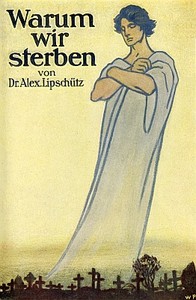
Warum wir sterben by Alejandro Lipschütz
Let's be clear from the start: 'Warum wir sterben' is not a novel. There's no main character or dramatic climax. Instead, think of it as a long, fascinating conversation with a brilliant and very old friend. Alejandro Lipschütz, a scientist who lived from 1883 to 1980, uses this book to explore the biological 'why' behind our mortality. He walks us through what was known in his time about aging, cell death, and the limits of the human body. He looks at everything from simple organisms to complex humans, asking why some creatures seem to age slowly and others burn out fast.
The Story
The 'story' here is the journey of an idea. Lipschütz guides us through the landscape of life sciences, pointing out the clues that explain our finite lifespan. He examines theories of wear and tear, genetic programming, and the role of evolution. It’s like a detective story where the mystery is death itself, and the evidence is found in our cells and our history. He connects dots between biology, a bit of philosophy, and the sheer observation of living things, building a case for why death isn't just a random accident but a deeply embedded part of life's process.
Why You Should Read It
What makes this book special is the voice behind it. You can feel Lipschütz's lifelong curiosity on every page. He’s not afraid to ask naive-sounding questions that are actually profound. Reading it feels less like studying and more like peering over the shoulder of a thinker who’s genuinely amazed by the puzzle he's looking at. It makes you look at your own life differently. Instead of fearing the end, you start to see the incredible, intricate machinery that even allows you to be here in the first place. It reframes mortality from a scary ending into a fascinating, if unsolved, scientific question.
Final Verdict
This book is perfect for curious minds who enjoy big ideas over fast-paced plots. If you like authors like Oliver Sacks or Carlo Rovelli, who make complex science feel human and immediate, you'll connect with Lipschütz's style. It's for the reader who sometimes stares at the ceiling wondering 'why are things built this way?' Be prepared for a thoughtful, slightly old-fashioned pace—it's a book to sip, not gulp. But if you give it your attention, it offers a remarkably peaceful and insightful perspective on the one experience we all share.
You are viewing a work that belongs to the global public domain. You can copy, modify, and distribute it freely.
Liam Hernandez
1 year agoAfter hearing about this author multiple times, it challenges the reader's perspective in an intellectual way. Thanks for sharing this review.
Dorothy Sanchez
2 months agoText is crisp, making it easy to focus.
Lisa Clark
9 months agoI came across this while browsing and the storytelling feels authentic and emotionally grounded. A valuable addition to my collection.
James Walker
10 months agoI came across this while browsing and the plot twists are genuinely surprising. Definitely a 5-star read.



Oliver Rodriguez
1 year agoClear and concise.