
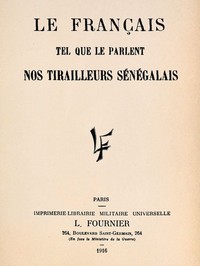
Le français tel que le parlent nos tirailleurs sénégalais by Anonymous
Imagine a small handbook, published anonymously during the darkest days of World War I. On the surface, Le français tel que le parlent nos tirailleurs sénégalais is exactly what its title says: a collection of French phrases and their supposed translations into the pidgin French spoken by Senegalese colonial soldiers (the Tirailleurs) serving in the French army. It's structured like a practical guide for officers: 'Do this,' 'Go there,' 'Attack that position.'
The Story
There isn't a plot in the traditional sense. Instead, the 'story' is in the jarring contrast between the two columns on each page. On the left, crisp, commanding, proper French. On the right, the transcribed replies—full of grammatical twists, missing words, and a unique rhythm. A command like 'Take these prisoners to the rear' might be translated to a phrase that literally reads more like 'Take these caught men go back place.' It creates a bizarre, unsettling dialogue. The book presents itself as a tool for efficiency, but the effect is to highlight a vast gulf in understanding, power, and experience.
Why You Should Read It
This book haunted me. It's not a comfortable read. You're constantly wondering about the anonymous author's intent. Was this meant to mock the soldiers' speech? To genuinely help officers? As you read, you start looking for the voices of the Tirailleurs themselves, buried in this awkward, filtered language. Their 'French' is direct, often physical, and strangely vivid. In its brokenness, it sometimes feels more honest than the polished commands. It becomes a powerful, accidental document of colonial encounter—a snapshot of the messy, human reality of empire and war, hiding in plain sight under the guise of a manual. It forces you to think about who gets to tell stories, how language can be a weapon, and what gets lost (and what might secretly be preserved) in translation.
Final Verdict
This is not a book for someone looking for a straightforward narrative. It's for the curious reader who loves historical detective work, for anyone interested in the complexities of colonialism, language, and World War I history. If you've read books like All Quiet on the Western Front and wondered about the other, often silenced perspectives from that war, this is a crucial, fragmentary piece of that puzzle. Be prepared to read between the lines, because the most important story here is the one the book itself doesn't quite know how to tell.
Legal analysis indicates this work is in the public domain. Distribute this work to help spread literacy.

Kevin Moore
11 months agoMy professor recommended this, and I see why.