
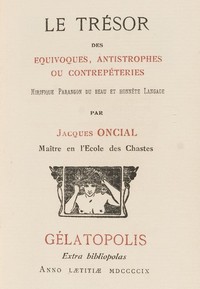
Le trésor des équivoques, antistrophes, ou contrepéteries by Léon Dupré-Carra
Let's be clear from the start: Le trésor des équivoques is not a storybook. You won't find heroes, villains, or a plot to follow. Instead, picture a scholar, Léon Dupré-Carra, sitting down in the late 1800s with a mission. His goal? To hunt down, catalog, and explain a very specific kind of French wordplay called the contrepèterie.
The Story
The 'story' is the hunt itself. Dupré-Carra acts as a collector and guide. He digs through literature, common sayings, and probably quite a few tavern jokes, gathering hundreds of these verbal puzzles. A classic, clean example in English would be swapping the sounds in 'a well-boiled icicle' to get 'a well-oiled bicycle.' His book is the treasure chest where he stores them all. He presents each one, often with a straight-faced, scholarly explanation of the swapped letters and the new, humorous (and frequently risqué) meaning that appears. The book is structured like a reference work, but the content is pure, unadulterated play.
Why You Should Read It
I loved this book because it’s a direct line to how people joked over a century ago. It’s social history disguised as a joke book. Reading it, you get a feel for the wit and the boundaries of the time. Some of the wordplays are incredibly clever, requiring you to sound them out loud to get the joke—a fantastic exercise for your brain and your French. Others are wonderfully simple. It’s also quietly subversive. Here’s a proper, published book giving a dignified home to humor that was often whispered in corners. It celebrates the idea that language isn't just for communication; it's a toy, and even the most respectable words can be flipped on their head for a laugh.
Final Verdict
This is a niche book, but a brilliant one for the right reader. It's perfect for word nerds, lovers of linguistic history, and anyone with an interest in French culture. If you enjoy puns, etymology, or digging through historical curiosities, you'll find this treasure trove fascinating. A fair warning: your French needs to be pretty strong to appreciate the twists, and some humor is of its time. But if you fit the bill, it’s a uniquely charming and insightful glimpse into the playful mind of the past.
This publication is available for unrestricted use. It is available for public use and education.
Emma Hernandez
6 months agoI have to admit, it manages to explain difficult concepts in plain English. Absolutely essential reading.
Joseph Jones
1 year agoComprehensive and well-researched.
Melissa Scott
1 month agoFinally found time to read this!
Emily Hernandez
11 months agoThe fonts used are very comfortable for long reading sessions.
Ethan Smith
2 months agoAfter hearing about this author multiple times, the clarity of the writing makes this accessible. I couldn't put it down.