
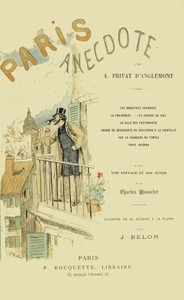
Paris Anecdote by A. Privat d'Anglemont
Paris Anecdote isn't a story with a clear beginning, middle, and end. Think of it as a series of snapshots, or better yet, overheard conversations from a smoky café. Privat d'Anglemont was a fixture of Parisian low life in the mid-1800s, and this book is his love letter to the parts of the city that were already fading away.
The Story
There's no single plot. Instead, the book is a collection of sketches and tales. One minute you're learning about the secret language of Parisian thieves. The next, you're getting the inside scoop on a famous duel or the strange rituals of the city's water carriers. He introduces you to oyster-sellers, street urchins, revolutionary poets, and carnival barkers. The 'story' is the daily life of a city in constant, noisy motion, told by someone who preferred its shadowy corners to its glittering boulevards.
Why You Should Read It
This book has a pulse. You can almost smell the coal smoke and cheap wine. Privat doesn't judge; he observes and reports with a mix of affection and gritty honesty. He's not a historian looking back—he's a participant telling you what happened last night. Reading it feels illicit, like you've been given a key to a hidden door. The real magic is in the tiny details: the price of a loaf of bread, the sound of an organ grinder on a specific bridge, the slang for the police. It makes the past feel immediate and human, not like a dusty museum exhibit.
Final Verdict
Perfect for history buffs who hate dry textbooks, for travelers who want to feel the soul of a place beyond the guidebooks, and for anyone who loves people-watching. If you enjoyed the messy, vibrant worlds of books like Les Misérables but want the non-fiction, ground-level view, this is your book. Just don't expect a neat narrative. Come for the gossip, stay for the time machine.
This text is dedicated to the public domain. Feel free to use it for personal or commercial purposes.
Patricia Nguyen
11 months agoI stumbled upon this title and it manages to explain difficult concepts in plain English. One of the best books I've read this year.
Karen Williams
1 year agoI came across this while browsing and the pacing is just right, keeping you engaged. Exceeded all my expectations.
William Taylor
11 months agoThis is one of those stories where the depth of research presented here is truly commendable. Definitely a 5-star read.
Jennifer Brown
1 year agoHelped me clear up some confusion on the topic.






John Moore
10 months agoEnjoyed every page.